
4.b.3. Internal coherence and compatibility: evolution of the species
-
Isomorphism in the evolution of the species
The first indication of the genetic system's compatibility is the uniformity in its language, the DNA.
Any improvement has to be compatible with the rest of the transmitted genome. There should be a subset of the genotype remarkably constant for affecting a lot of vital processes. It is the structural code.
NEWS ABOUT THE THEORY OF EVOLUTIONA year after the official presentation of the rough sketch of the human genome
In the human genome are also many proteins related to the defense system of the organism and, especially, a high number of repeated sequences and without a known function that makes up 50% of the total (the genes would only represent 1.5%)
El País 20-02-2002.
The existence of random genetic variability or mutations would mean they would affect the structural code. The consequences would be disastrous for developing the new being; logically, the modifications generally cannot be random, especially in too complicated cases as the human genome.
The random method in the evolution of the species is acceptable within specific processes and mechanisms; that is, nature extends the range of possibilities without affecting those functions requiring uniformity and coherence.
The existence of uncontrolled random mutations should lead to the presence of spiders with four, six, or more than eight legs; moreover, they should be born more or less continuously over time. It should be regular to find animals of the same species with more legs and humans with three arms. Modern genetics is indeed acquiring this type of mutation in inferior animals.
The coherence of the modifications also relates to the genetic information the other parent could transmit. Sexual differentiation allows –apart from other numerous considerations– a method for achieving the necessary uniformity and coherence between the two sources of genetic information and the observed isomorphism in the species. We are referring to the Logical Verification of Information method –LoVeInf.
-
Evolutionary leap and the origin of new species
A related aspect to coherence is the possibility of evolutionary leaps in the origin of new species, which will imply a change of the structural code. In other words, any model should justify the existence of the human genome. *
When a system evolves, it complicates, and some traits make up its structure while many others are depending on them. Eventually, this structure becomes ancient. There comes a time when it is necessary to change some configuration elements to simplify processes and increase the evolutionary potential.
With new functions will not operate the Logical Verification of Information method. A simulation method or other condition of control should check the new feature. One solution to assure the continuation of the species could be incorporating the modification to a certain proportion of the descendants.
Fast changes will follow a structural shift that will produce traits related to and dependent on the new functions, for example, the necessity of a particular protein. If a new being does not acquire this new protein by combining genes, it will not survive, given that the dependent traits will remain blocked in the phenotype.
NEWS ABOUT THE THEORY OF EVOLUTIONWhat we have of Neanderthal
Scientists reveal that Europeans and Asians have 1.3% of that population’s genes in hair and skin. So, the two species crossed and produced some fertile offspring, those portions of the Neanderthal DNA passed to the next generation, but at a cost, because the mixture of both species “was at the limit of biological compatibility.”, says geneticist David Reich.
El País 30-01-2014.
The species will be compatible * during a specific period while distancing between themselves. Still, evolution will make them irreconcilable for reproductive purposes, causing their complete separation and new species' origin.
The sporadic diseases, one case out of every 10,000 or 100,000, could respond to this argument since usually, they are due to the lack of a protein in the phenotype –organism– by two very archaic genes together. These genes are reminiscent because individuals with the new structure, and those from both parents, have not been viable.
NEWS ABOUT THE THEORY OF EVOLUTION“The responsible gene of a protein called growth factor 2, similar to the insulin (IGF2), is usually marked in people.
The imprinted IGF2 from the mother is typically not active in the child, but when it loses that marking and activates, it produces cancer in infants called Wilm tumor.
It is a radical concept in genetics. Because until now, we did not know cancers caused by normal genes."
El País 26-04-1993. Nature
Of course, as always, it can sound like natural selection because any mechanism impeding the viability of a being could be part of it, but it would be nothing more than an abuse of the concept in its purest tautological form.
Complementary traits and the origin of the species
Conditions of the modified code's active development could be other related traits to extend possible improvements.
The balance of complementary traits also concerns with coherence.
When two traits are entirely complementary, their balance is beneficial, given that the resulting potential will be higher. The figure shows the effect of the complementarity factor on a particular characteristic. The outcome should be superior to the simple addition. In the graphic, the example assumes the subsequent potential is the product of the individuals’ potential.
The complementarity of intelligence and memory could be each additional component –a typical example can be the human genome– of the processor will increase the potential not in a unit but instead in the total memory quantity.
A familiar analogy in the trunk of a car: when going on a long trip and with many junk pieces, one should pay particular attention to fit them all. The grander the ability and the trunk, the more things that can do inside.
In assessing the effect for greater clarity, the ability goes from three to four objects by a unit of volume, and this one from four to six. Then, the skill has increased one, the size two, and the number of objects twelve by the effect of complementarity.
This effect is of extreme importance since the maximum difference of potential of every trait isolated has the relationship 9 / 3 = 3, and globally the relation transforms to 81/9 = 9. It has tripled.
Complementarity of abilities in the phenotype 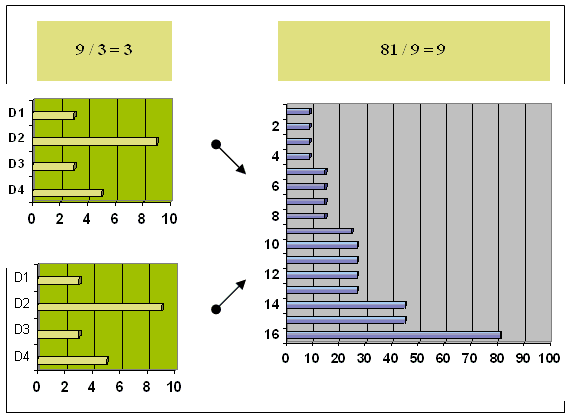
Enormous differences could occur in potentials associated with multifunctional characteristics, like intelligence and memory. Only with the introduction of another trait, the individual relationship of 3 could go to 729 / 27 = 27.
Now, we can imagine that three different ape species live in a relatively close habitat. One of them lives mainly in the trees, another on the ground and another near a big river. Suppose the three species genetically mix ** through their more gifted individuals. It is easy to imagine that the descendants could acquire traits highly superior to their ancestors, and the subsequent mechanisms will end up separating the new species. **
The new species’ babies’ **only problem will be finding its missing link because it had never existed. **