
4.b.2. Efficacy and optimization
4.b.2.a) Phenotype and efficacy of genotype
Teleological or finalist evolution
The majority of genetic variability cannot be random in genomes or complex systems due to the interrelation that changes will necessarily have. Likewise, it would be tough in the case of an evolutionary leap –generating a missing link. If the existence of non-random variability is accepted, it should be easy to admit modifications in the genotype due to environmental conditions, as Lamarck suggested.
NEWS ABOUT THE THEORY OF EVOLUTIONOur chromosomes have many hitchhikers, ‘mobile elements’ that go leaping through the genome and inserting new copies of themselves during the trip. These parasites, which make up almost half of the human genome, destroy but also create.
El País 28-02-2001 WRONG - (WELL)
If a cell needed to create a more rigid membrane than its genetic load expected, it must have modified its genotype. If possible, the cell will incorporate its genotype changes * to the genetic information of its descendants.
There are always aspects to improve in the phenotype and not only for environmental purposes; probably, maybe millions in superior animals.
The improvements will be more successful in life and with the mechanism of natural selection. Still, the source of evolution is the first improvement through the non-random genetic variability.
For example, in cellular biology could be two proteins with similar structures and independent functions created by different genes. If one of them can perform both tasks with a small modification, it will enhance efficiency.
Sexual differentiation and genetic variability
Sexual differentiation also allows us to choose between two lines of evolution and achieve the objective of improving living beings and, in short, of life. In some way, there should be a mechanism permitting to pick off the optimal genotype or source in each particular case. If a gene is operative or significant, it should be for some reason or cause, and there was a moment in which its significance showed.
The genetic information or genotype has instructions to develop the new being and conditions of development of such guidelines; it is epigenetics in a broad sense. An easy solution could be gene markers to behave like dominant. However, it is very doubtful because there will be a problem when the two genes have the same tag.
Possibly, it incorporates related information, such as the first generation **, which included the new code in the genotype, or if it has a structural nature, which would be similar to marking it as dominant, but conceptually different.
Somewhat, it will incorporate information of dependent parts of the genetic code. The development of particular characteristics implies associated fragments.
NEWS ABOUT THE THEORY OF EVOLUTIONScientific advancement and society
Much to learnThe genes of each organism include all information for its properties, and they encode regulatory instructions that, when performing, govern how this information expresses.
El País 26-11-1992. Eric H. Davidson.
-
The backup copies
A high proportion of the genetic code in the genotype seems not to develop the new being. Suffice to recall news about the human genome attracting the Y chromosome’s attention regarding how small it is and the number of non-operative genetic codes. It appears nature does not eliminate the modified portion of the genome but keeps a copy just in case. It is uncertain why, but an experienced programmer would effortlessly understand the utility of a non-operative code in the configuration of any computer program could have. In any case, the non-operative genetic code must have a means of identification.
Like a programmer, if living beings had information and methods to reduce the risk of introducing new genetic information in their genotype, they could carry out many more modifications.
Evolutionary leaps and the missing link
The evolutionary leap provides another argument to improve the efficiency of the genetic information regardless of its reason and if it causes a missing link or not. The rejection of an evolutionary jump by random mutations is much higher since it would impede the existence of a possible missing link or significant gaps in the fossil registry.
In the first stages of an evolutionary leap will be a lot of redundant genetic code. The next evolutionary step will be a simplification of the genetic code. Once this rationalization finishes, nature will be ready to continue adding small modifications in the genotype that may improve and expand the existing beings’ capabilities.Any vital impulse system will go through these steps. An example would be a computer program, which is the easiest to understand. They add code to perform additional functions or improve the efficiency of features already present. However, there comes a time when programmers realize that many additions have identical or very similar parts. Each time there is a modification, it needs many adjustments to maintain its coherence and allow future acquisitions. Then, restructuring is necessary –a qualitative leap or evolutionary leap that will be more than profitable even if it means considerable work. Furthermore, these new versions will be different, causing a potential missing link.
Another clarifying example is the work of joining two programs into one to achieve particular advantages.
The reader can consider real-life examples that have followed a similar process. Indeed, many historical events had the same dynamics. Let us think about the enactment of a Constitution with effects on the laws to the judicial system.
4.b.2.b) Resources optimization and natural selection
-
The scarcity of resources and natural selection
Nature is in a world where resources are scarce, and the survival of descendants is not guaranteed.
In general, vital impulse systems need to evolve as quickly as possible. It is not always enough to do it well; they have to be the best because of natural selection mechanisms.
In other words, natural selection is acting as an accelerator in evolution.
One characteristic derived from the evolutionary velocity and the scarcity of resources since the origin of life is the optimization of resources.
These two characteristics have a special force due to the very design of life that imposes constant competition and struggle. Therefore, they are real objectives of the evolution of vital impulse systems.
There is a metaphysical question regarding these objectives, why does the design of life involve many living beings feed on others, and many of them end cruelly?
Sexual differentiation and germ line evolution
The sexual differentiation adopts –besides the other multiple considerations– methods of speeding up changes in genotype, allowing to incorporate functions coming from other living beings' genotype.
In germline evolution, only one individual's experience can transmit to the next generation. The growth of just one line is slow.
Germline evolution Sexual differentiation 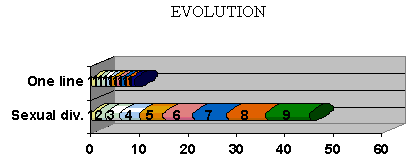
If different experiences manage to join, evolution will be more fruitful and let the Logical Verification of Information method –LoVeInf.
The graphic shows the difference between incorporating new genetic modifications with germline evolution and sexual differentiation along generations. Assuming individuals had the same genotype initially, after six steps, accumulated changes with germline evolution would be the third than with sexual differentiation; after nine, the ninth, and so on.
The external origin of evolution will be higher the more mature the individual is, especially in those improvements affecting functions working only in the adult stage. It could be a biological and not cultural justification of the female preferences for adult males in many species. In contrast, males prefer young females because they have a healthier body to carry out their initial development's complicated and challenging task.
NEWS ABOUT THE THEORY OF EVOLUTIONThe solution to an enigma of the bees presented 150 years ago.
The csd gene was a remarkable invention of the ants, bees, and wasps and their complex societies because it allowed the haplodiploid progress.
El País 10-09-2003. Cell.
Between germline evolution and sexual differentiation is the primary or endogamy sexual differentiation. For example, bees have males, but they always fertilize the queen of the beehive. In this case, it is more probable that one genre passes a complete backup copy, and the other provides some improvements in the genotype. This endogamic nature will not allow the LoVeInf method. However, it could work with a generational gap, so the filter happens between different generations' modifications.
On the other hand, when the LoVeInf method is not feasible, nature would look for the reliability on the goodness of the modifications by other means. For example, exhaustive testing will take much time and work, so the sex responsible for producing the changes should be free of hard work. In any case, the topic of the famous “drones” should have some explanation.
The relevance of genotype optimization
Going back to the optimization of resources, any repetition of an evolutionary phase is a step back from wasting time and energy.
NEWS ABOUT THE THEORY OF EVOLUTIONIt merely deals with getting the best performance possible from the investments made, whether of time or effort.
El País 02-10-2002. National Conference of Ethology
Some species sacrifice the male after the union, so the repetition of an evolutionary step becomes impossible. Visibly, nature takes time very seriously.
NEWS ABOUT THE THEORY OF EVOLUTIONA study about the Spanish mountain cat proposes to modify the theory of evolution.
El País 10-01-1993. Journal of Neuroscience
Likewise, we have already talked about the possibility of associating conditions of development with other related traits. Therefore, possible modifications will develop in a generation after the following, guaranteeing changes would be operative after testing their usefulness in more than one evolutionary step.
NEWS ABOUT THE THEORY OF EVOLUTIONWe do not question the theory of evolution, but
Adaptation to different environments using a mechanism of selective killing of brain cells before the birth gives the animal the capacity to recover eliminated features if the milieu changes suddenly.
This mechanism is an enormous evolutionary advantage and allows the domestic cat to develop color vision again if it had to go back to hunting in the daytime.
El País 15-01-1993. Journal of Neuroscience
Optimization and fast evolution may justify this mechanism. If genetic changes due to environmental conditions were directly operative in the following generation, there would be a risk of undoing them. Likewise, revert all of the changes and adjustments derived from them, in short, a waste of time.
NEWS ABOUT THE THEORY OF EVOLUTIONThe inheritance of the acquired characters
Some experimental studies show some acquired characters; the fundamental idea is that these concept characteristics must have passed through the sperm or ovules.
An example is a type of brown rats.
El País 10-05-2008 Big. broken dogmas
Genetic variability and phenotype
As we have discussed in Guarantee and Certainty, with the LoVeInf and others, many more modifications can change the genotype without affecting the new being's viability. The number of genotype alterations carried out in each generation is so high that without the LoVeInf method, the offspring would not have decent future perspectives.
NEWS ABOUT THE THEORY OF EVOLUTIONThe small human chromosome Y wholly arranged in the sequence contains 78 of approximately 30,000 genes that make up the human genome.
According to the studies, in one generation, chromosome Y alters in 600 units.
El País 21-06-2003. Nature
The children of two parents that, in turn, are siblings imply an example. The LoVeInf method is applied, but there are numerous recent and equal modifications. Therefore, its filter function will not be efficient enough and will not avoid visible and significant damage to the descendants.
The fact above infers evidence of the number of modifications in each generation and indirectly of its non-randomness. It would be the only way for brother and sister to have the same genetic changes.
In addition, keeping in mind the system's complexity and sensitivity, random mutations’ effect on the phenotype would be more dangerous on vital functions. Those tasks practically cannot accept arbitrary changes. A small error would be enough for the non-survival of the new individual, and natural selection does not allow this type of mistake.
We can find examples of random mutations with devastating effects in historical events, such as dropping the atomic bombs at the end of the Second World War in Japan. More cases, although imaginary, in the movies of the 1950s.
NEWS ABOUT THE THEORY OF EVOLUTION95% of the current genetic variability already existed when the species was born.
Seven scientists in the United States, Russia, and France publish today in Science the most general analysis on human genetic diversity.
In each person, they analyzed 377 markers in the DNA –called microsatellites. They evolve remarkably fast, detecting any minimum hereditary variation since the current humans emerged in Africa some 50,000 years ago.
El País 20-12-2002. Science
In complex systems, comparing an independent source is the only way to get close to a specific aspect's certainty. Moreover, if changes were always random, the LoVeInf method would not make sense. Due to the magnitude of the genetic code, they would rarely happen in the same function.
The statistical EDI study –Evolution and Design of Intelligence– proves the existence of the LoVeInf method.