3.a.1. Theory of Creationism vs. evolution
We mention Creationism and other religious philosophies because they relate to evolution theories, and many people agree with them in one or another way.
As this notion does not follow the scientific method, the critic cannot base it on logical thinking; only showing our deep respect for religious beliefs.
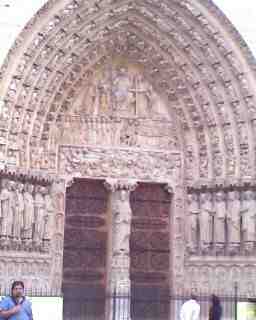
Paris
A similar problem arises studying the existence of the soul-body (monism and dualism) and, although to a smaller degree, the concepts mind-brain (logical behaviorism - Wittgenstein, identity, and functionalism). They are in the scope of theology and philosophy more than in science.
In any case, religious positions such as Creationism can be compatible with any evolutionary theory, with a metaphorical interpretation of specific explanations of life's origin with a religious character.
3.a.2. Intelligent Design
The general theory of the Conditional Evolution of Life –CEL– does not coincide with the Intelligent Design movement, such as the pseudo-tautological idea of the design of the universe to admit biological life, as we know it. However, it coincides with its argument of the existence of a teleological or finalist evolution consequence of an intrinsically vital impulse.
Naturally, it undergoes the same attitudes when some humans confuse Intelligent Design –an evolutionary theory– with Creationism and do not accept its scientific nature. As if excluding a theory’s character without a strong reason was purely an act of pure science!
Although the Conditional Evolution of Life is wholly rooted in the scientific method and experimental research, there is a connection with the Intelligent Design movement. The CEL supports a spiritual vision to the extent to which all religions come together. That is to say, the objective existence of the aforementioned vital impulse that seems to give meaning to life.
However, any scientific evidence of evolution being finalist would not imply, in its case, that other aspects suggested by theory of Intelligent Creationism are correct.
Furthermore, the Conditional Evolution of Life is not a part of this trend or movement.
Nevertheless, the subject of Intelligent Design seems particularly significant for the following reasons:
-
It is crucial that part of religion, call it Intelligent Creationism, Scientific Creationism Theory, or Intelligent Design movement decides to make its beliefs compatible with the scientific world's physical reality.
Thus, science, or rather, the scientific community, will find itself forced to the corresponding; that is, not to reject something that it has no evidence to disprove and, therefore, accepting that some ideas like those of Intelligent Design could be valid.
The scientific community also would be obliged to recognize that Darwin’s preferred evolutionary theory is neither proven nor rigorously formalized. They have made a severe error in the past by accepting it as such.
The entry into science would prompt a greater seriousness in the Intelligent Design and the Darwinian Theory of evolution or the currently widespread Neo-Darwinism.
For example, both theories should explain the concept of Life, when and how they think the universe began and persisted until the present time. Note that until now, one focused on Life and the other on species!
Creationism and Darwinism should separate from science the non-verifiable assertions –such as a tautology or anything appearing out of nowhere without saying precisely when.
Another essential element of Intelligent Design’s dynamics is the small revolution within its ideas because it will need to place the designer in this world to produce evolution.
That is to say, there is an intelligence producing small changes throughout time, which makes evolution take place. Therefore, it seems sensible that this intelligence would be tiny, not typically human, and even belonging to a micro-scale. In other words, with Scientific Creationism, humans are no longer the only intelligent beings and with the spirit of improvement.
With the revolutionary movement, the religious sentiment would be transcending beyond humanity regarding intelligence, which is encouraging because it implies becoming more rational.
All needed for modern science is to undertake a similar route and abandon some of its nineteenth-century premises, preventing it from being neutral regarding essential concepts, such as life evolution.
3.b.1. Lamarck's theory of evolution
It depends on environmental factors and is summarized as “the function creates the organ.”
We consider Lamarck's theory of evolution as valid but not general. Among other concepts, it should explain the controls imposed by nature to avoid modified characters' development due to non-permanent environmental changes.
Its philosophical implications indicate a creative intelligence different from the human one because there must be adequate mechanisms to create the organ.
There is a brief description of the Theory of Lamarck in chapter 9.