
3.c) Laws of Mendel
Contrary to Darwin’s theory, Mendel's laws have always been a clear example of inductive reasoning. Some controlled experiments give place to an accurate theoretical interpretation within its context. However, we must keep in mind the existing knowledge at the time.
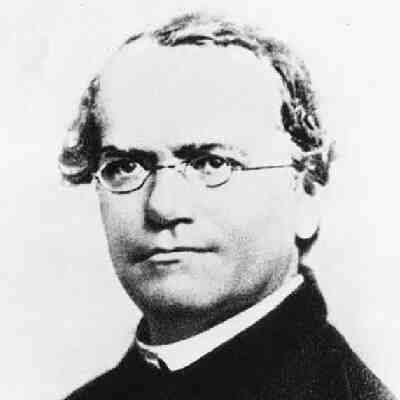
Usually, there is no attempt to present Mendel's laws as a theory of evolution –due to the distortion of the meaning– since just a combination of genes does not produce different traits from the originals.
Mendel's laws introducing previously unknown elements or mechanisms of evolution did not help Darwin much either. It is no surprising the scientific community ignored Mendel’s contribution for 50 years; hard to understand without the sociology of science of Thomas Kuhn.
Due to the dynamics evolution implies, and given the multiple advantages of sexual differentiation, the general theory of the Conditional Evolution of Life –CEL– understands Mendel has provided a remarkable contribution in its correct meaning. Moreover, it maintains its applicability with appropriate conceptual adjustments.
The initial interpretation of genetic heritage laws does not raise any problems since it is accepted, and the general advancement of science has updated it. However, what can indeed pose some serious issues is how schools keep explaining them.
The approach of the concept of the dominant and recessive gene is a little archaic. There can be conceptual difficulties, such as “What happens when two dominant genes come together?” Academia resorts to concepts like co-dominance, and it seems the genetic mechanisms are unknown. Nonetheless, scientists know those genetic mechanisms, at least partially, but they cannot elucidate them straightforwardly based on the simple concept of dominance and within the context of general randomness.
A little more challenging to clarify, with the classical ideas, would be the concept of co-recession.
According to the CEL, the concepts of dominant and recessive genes alter their essence in the evolutionary process. A gene is not dominant or recessive, but instead, it behaves depending on which another gene is working –the classic thought shares this idea. However, a new concept contributed by the alternative theory CEL is that the behavior depends on genetic information development restrictions. The best example is the verification or non-verification of information between the two sources.
Due to Mendel’s laws' relevancy, it cannot be enough to say a gene is dominant or recessive; there have to be arguments explaining why. Mostly, the concept maintains its original meaning because the traditional idea of discrete gene characteristics –red, white, pink, but not tones in full evolution– is more convenient for the prevailing notion.
Basic concepts of dominant gene and recessive gene cease making sense, and in the event of maintaining, they turn out to be incorrect. The so-called recessive gene ends up being the most powerful and modern when the verification is one of the conditions associated with the transmitted genetic information. Consequently, the CEL changes the terminology, categorizing the gene behaving as dominant as the significant gene.
There is a brief description of the Theory of Mendel in chapter 9.