
4. HISTORICAL ERRORS OF THE SCIENTIFIC METHOD.
4.a) Research methodology
It is not easy to understand why there are enigmatic paradigms; the scientific method made such big mistakes and kept making them. Fortunately, Kuhn’s sociology of science explains not only the reasons but also the difficulties to admit and rectify the previous errors.
Concerning the constructive criticism, an additional complication is that when a person realizes that there are significant flaws in the orthodox doctrine, begins to distrust even the most essential elements.
This chapter will discuss the foremost errors with particular reference to the research methodology of the theory of evolution for being absolute absent and far away in some islands, and the dynamic development of the Modern Physics, that is, of each stage of history.
Many of the problems derive from the very same misunderstanding of evolution and the egocentric humanism, despite the initial contribution of Darwin when showing that humans come from apes.
Before exposing the mistakes made in each science branch, let us look at some of their general causes:
Life aesthetics
How can it be understood that intelligence has not changed in the last 2000 years? This generally shared assertion would imply it has taken enormous leaps in early stages because it seems evident there are quite a few differences between humans and their ape-cousins.
The page about the historical and human evolution of the CEL book cites some of the consequences, and relevant facts of man’s biological evolution and its stages of research methodology. Moreover, it describes some erroneous elements, which will affect derived arguments.
Therefore, it will be necessary to find other elements making up for the mistakes from the structure produced to be compatible with the part of reality that is not open to loose interpretations.
The same argument can apply the language research methodology. The general idea is that all languages are in the same stage of development and have a similar number of words. There are no precise statistics on the evolution of the number of terms of each language throughout the recent history of humankind. Logically, it should be some relation between the number of words and the intellectual capacity of the individuals.
However, it is more appealing to say language is an innate characteristic in all humans, and that the variations among some other groups, current as well as historical, and some other individuals are random. Each one has its aesthetics, but the scientific methodology tries to reach the objective truth.
Furthermore, the aesthetics of reality may be better than usually thought at first impression. An appealing objective of life is to find the divine aesthetic of the essence of existence.
Complexity of science
The EDI Study 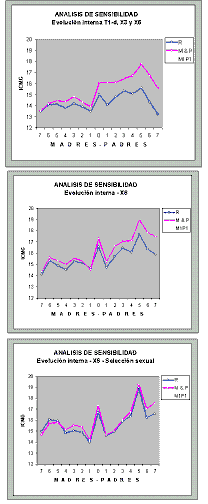
On the other hand, the success of specific scientific theories relates to the possibility of conveniently explaining the complexity of reality for the different acting groups of society, without visibly leaving the scientific methodology.
Suffice to say scientific research is always in the limits of the unknown.
The most challenging aspect of criticizing a theory is to understand it well enough. Another problem is to convince oneself that the scientific community is wrong. It would be funny to make a criticism, and receiving a reply like: “That is figurative speaking, a metaphor, and no scientist believes it.” Well, many people continuously do it and in every possible sense, and usually without understanding what they are saying!
One day at university, talking with a graduate in physics about various topics related to time, he said that he could not continue because I did not know what time was. He did not have time to explain it because it was very complicated. We agreed to end the conversation quickly, but our thoughts did not coincide with the objective reasons for the impossibility mentioned above. I have always known what time is!
Unattainable objectives
Another big mistake belongs to the research methodology of learning and psychology. It has been the rejection, or excessive criticisms of specific proposals that were correct, but did not offer absolute certainty. Of course, it is fine not to guarantee what is not sure in complex systems, but that should not mean not recognizing the value in the majority of the cases, and, therefore, with these limitations, maintain the opportune doctrinal positions and not go on to the contrary.
Ad hominem fallacy
An important issue is the ad hominem fallacy or to argue against someone for the lack of an academic degree instead of arguing against the reasoning. When there is no argument, we could cite the fairy tale of The sly ones of the Inquisition.
The lack of humbleness in science
On various occasions, there is a tendency to say that there is evidence for a specific topic when there is not. Perhaps it is more probable or verisimilar in one stage of the research, but it is not the same.
This behavior hinders the constructive criticism of individuals that accept the supposed validation of the established theories.